
The Future of AI blog series is an evolving collection of posts from the AI Futures team in collaboration with subject matter experts across Microsoft. In this series, we explore tools and technologies that will drive the next generation of AI. Explore more at: https://aka.ms/the-future-of-ai
Imagine a world where AI-powered agents seamlessly assist human professionals, guiding sales reps during calls, helping IT teams troubleshoot in real time, or aiding doctors in documenting patient interactions. These agents can listen, analyze, and act during live conversations, helping reduce cognitive load, automating routine tasks, and delivering real-time insights – ushering in a new era of AI-augmented human expertise.
Across industries, while having a customer interaction the representative must juggle multiple responsibilities – actively listening to customer needs, filling out forms, performing research, recommending suitable options, tracking next steps, and ensuring timely follow-ups. In more complex scenarios like customer account updates, additional business workflows come into play, including fraud detection, credit checks, and compliance verifications. These tasks involve a mix of sequential and parallel processes, which can make them both time-consuming and cognitively demanding.
AI-powered customer support can transform this experience by leveraging AI-powered agents and intelligent agent orchestration to handle operational complexities in real time. While the representative focuses on providing a personalized and engaging experience for the customer, AI agents can work in the background to:
- Listen and assist in real time: Extract key details from the conversation and identify necessary tasks.
- Automate form filling: Help reduce manual data entry by populating forms based on customer inputs.
- Recommend products: Use contextual insights to suggest tailored solutions and recommendations.
- Analyze customer sentiment: Constantly analyze customer sentiment to enable more empathetic and personalized interaction.
- Execute business workflows: Trigger automated fraud checks, credit assessments, and compliance verifications as needed.
- Track and manage follow-ups: Help ensure seamless post-call actions for continued engagement.
By intelligently orchestrating multiple agents, AI-powered customer support streamlines traditionally manual workflows, enhancing both efficiency and customer satisfaction. This enables seamless, AI-powered experience where operational bottlenecks are minimized, and businesses can focus on building meaningful customer relationships.
Customer Assist is an enterprise-grade agent code sample that helps development teams create AI-powered agents that can transform customer service operations. By leveraging the Microsoft Semantic Kernel Process Framework and Azure AI Foundry Agent Service, this solution empowers customer service representatives with real-time insights, contextual assistance, and automated workflows.
| Capability | Technology |
| Orchestration | Microsoft Semantic Kernel Process Framework |
| Multimodality | Azure AI Services: Content Understanding, Text-to-Speech, Speech-To-Text |
| Observability | Azure Application Insights, Custom Telemetry |
| Evaluations | Azure AI Evaluation SDK |
| Models | Azure OpenAI (GPT-4o), and DeepSeek in Azure AI Foundry Models |
| Safety | Azure AI Content Safety |
| Knowledge | Azure AI Search |
- Multi-agent orchestration: Codify your business processes and embed intelligence using specialized agents. Seamlessly orchestrate them with Microsoft Semantic Kernel to power intelligent business workflows.
- Multimodal support: Handle text, images, audio, and documents in real time. Transform unstructured data into structured insights that can be used by customer support teams.
- Bring your own LLM: Use any language model tailored to your needs. Allocate tasks to specialized models while optimizing cost and performance.
- Agent evaluation & observability: Monitor agent behavior and system health in real time. Analyze usage, performance, and quality against operational benchmarks.
Figure 1: Customer Assist Architecture Diagram (For the purpose of the demo two agents have been leveraged to simulate real-time Customer-Business representative conversations)“>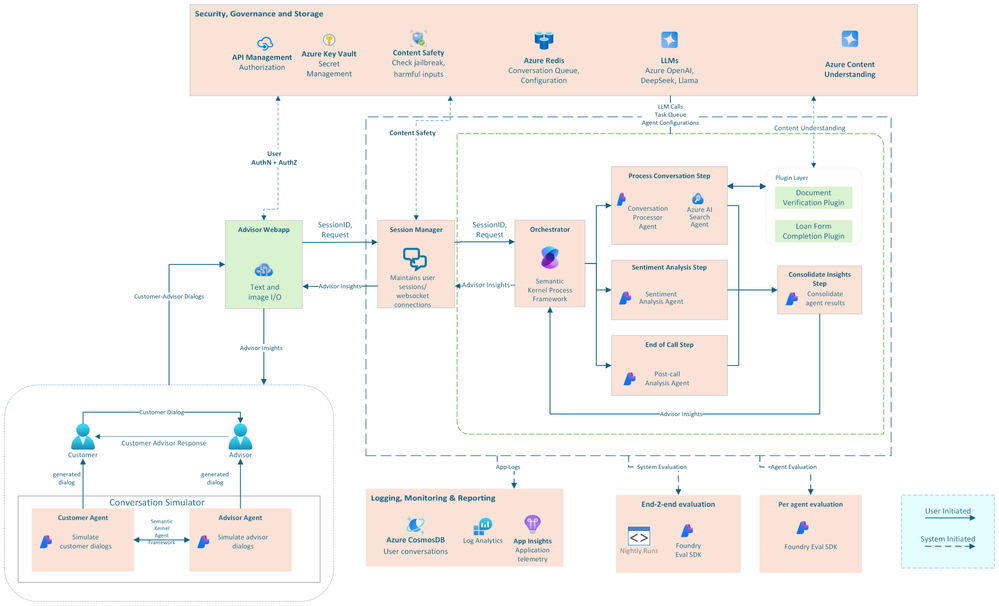
Figure 1: Customer Assist Architecture Diagram (For the purpose of the demo two agents have been leveraged to simulate real-time Customer-Business representative conversations)
While our system pushes the boundary of what’s possible, key challenges remain:
- Latency: Millisecond-level processing is critical. Optimizing STT, LLM calls, and reasoning engines is ongoing work.
- Security & compliance: Agents must redact PII and operate under regulations like GDPR/CCPA. Azure AI Foundry data handling practices are key – they ensure secure data flow, enforce access controls, support regional data residency, and enable auditability. These practices form the backbone of compliant and trustworthy AI operations.
- Trustworthy AI: Bias mitigation, fairness, and human-in-the-loop controls are essential for Trustworthy AI.
- Multimodal AI: Beyond text & images, analyze facial expressions, tone, and behavior for deeper customer insights.
- Persistent AI memory: Carry context across sessions for more personalized support.
- Explainable & auditable agents: AI agents consisting of explainable reasoning – especially needed in regulated industries like finance and healthcare.
AI-powered agents are here to stay—augmenting humans, automating the mundane, and transforming customer interactions. As the ecosystem evolves, agent-based solutions will be key to unlocking intelligent, scalable, and human-centric engagement models.
👉 Explore the code: Customer Assist on GitHub
📽️ Watch the demo: Customer Assist Demo
🛠️ Build your own: Customer Assist Architecture Overview
Let us know how you use this solution – your feedback will help shape the future of AI agents!