
A suite of solvers is included in Simcenter STAR CCM+ for solving problems involving complex geometries and physical phenomena. The wide range of physics models includes CFD, computational solid mechanics, electromagnetics, heat transfer, multiphase flow, particle dynamics, reacting flow, electrochemistry, aeroacoustics, and rheology. One of the major applications, aerodynamics, can also be analyzed with Simcenter STAR-CCM+ and designs can be optimized to reduce drag and reduce weight.
The performance tests of Simcenter STAR-CCM+ are carried out using HBv4-series VMs available on Azure.
The HBv4 is built around the AMD EPYC 9V33X (Genoa-X) CPU, which provides the base frequency of 2.4GHz (3.7GHz peak) and an astounding 176 non-hyper-threaded cores. The increased 768 GB of main memory (and even 1.4TB on the HX -series), together with 1.8TB of nvme local scratch and 400Gb/s Infiniband provide a well-balanced and increasingly powerful VM for these CFD workloads.
The performance results achieved by running Simcenter STAR-CCM+ in parallel on single-node Azure HBv4 VMs are presented below. Four models were considered for single-node tests. Based on the single node tests, a suitable VM configuration is selected for the multi-node runs.
These small models have a maximum of 20M cells and are therefore good representable models which will be run on single instances in production. This table shows the average elapsed time of 3 trials for each model for varying numbers of vCPUs on the Standard HBv4-series VM:
cores/ vCPUs | average elapsed time(seconds) | ||||
| Civil_20m | Lemans_17m | Reactor_9m | Hlmach_6m | ||
| Standard_HB176-24rs_v4 | 24 | 4.742 | 3.407 | 1.847 | 3.272 |
| Standard_HB176-48rs_v4 | 48 | 2.422 | 1.798 | 0.948 | 1.706 |
| Standard_HB176-96rs_v4 | 96 | 1.451 | 1.039 | 0.524 | 0.986 |
| Standard_HB176-144rs_v4 | 144 | 1.225 | 0.848 | 0.408 | 0.788 |
| Standard_HB176rs_v4 | 176 | 1.160 | 0.813 | 0.383 | 0.739 |

The following graph shows how the relative speed increases as the number of vCPUs increases:
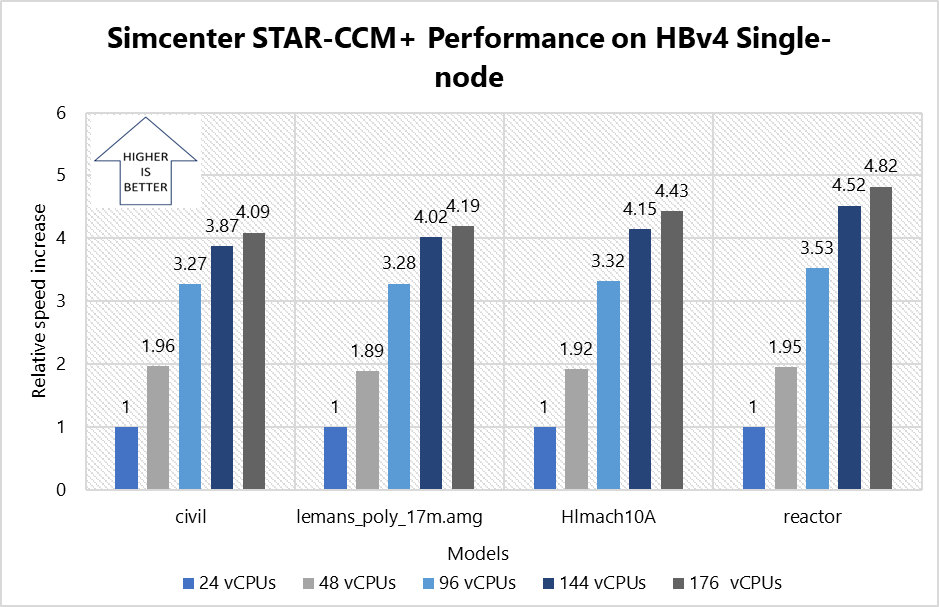
The above graph shows the initial scaling, up to 144 cores being very strong. After that, the memory bandwidth appreas to become saturated and the continuing scaling is less strong. Since the price of the vm does not change for the amount of cores used, the most price-efficient way of running these models is by using the full 176 cores.
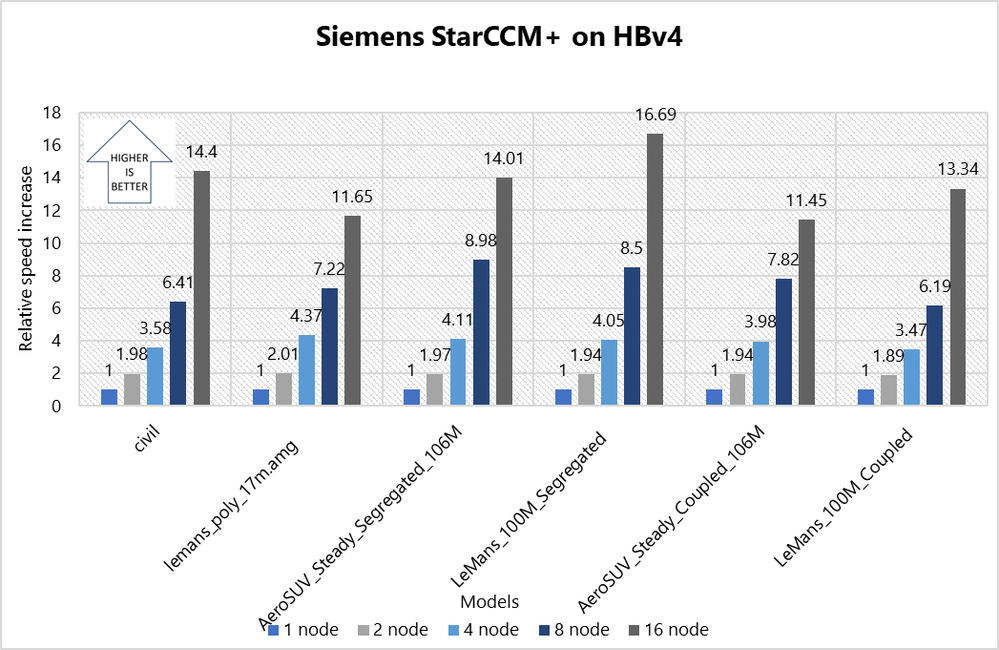
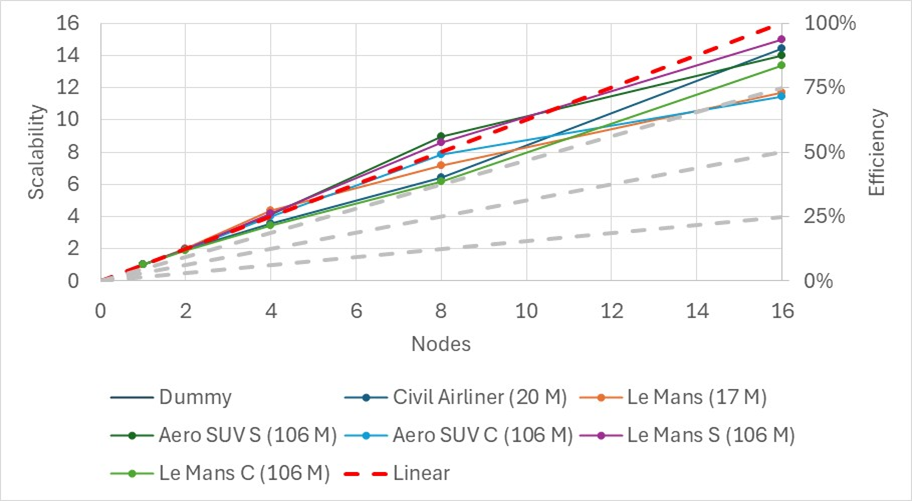
The single-node tests carried out with Siemens STAR-CCM+ confirmed that the most price-efficient way of running the solvers is at 176 cores on a HBv4 VM. Therefore, we employed only 176 cores to evaluate the performance of Simcenter STAR-CCM+ with Standard_HB176rs_v4 when testing multi-node (cluster) configurations.
VMs | cores/ vCPU’s | average elapsed time(seconds) | |||||
| Civil 20m | LeMans 17m | SUV 106m_S | SUV 106m_C | LeMans 100m_S | LeMans 100m_C | ||
| 1 | 176 | 1.152 | 0.784 | 3.279 | 10.435 | 3.304 | 4.268 |
| 2 | 352 | 0.581 | 0.390 | 1.666 | 5.377 | 1.704 | 2.258 |
| 4 | 704 | 0.322 | 0.180 | 0.798 | 2.621 | 0.817 | 1.231 |
| 8 | 1408 | 0.180 | 0.109 | 0.365 | 1.335 | 0.389 | 0.690 |
| 16 | 2816 | 0.080 | 0.067 | 0.234 | 0.912 | 0.198 | 0.320 |
To run your own CFD models using Simcenter STAR-CCM+ on Azure, use the Cyclecloud Workspace for Slurm (Overview of Azure CycleCloud Workspace for Slurm – Azure CycleCloud | Microsoft Learn) from the Azure Marketplace. This will help set up a Slurm HPC cluster in just a few clicks, on which you can install and run your CFD models.